Coimbatore
Bachelor of Engineering Program

Robotics and Automation

Image link

Developing Competent Computing Professionals for an Intelligent and Connected World

Register
Download Brochure
Image link

B.E. Robotics and Automation

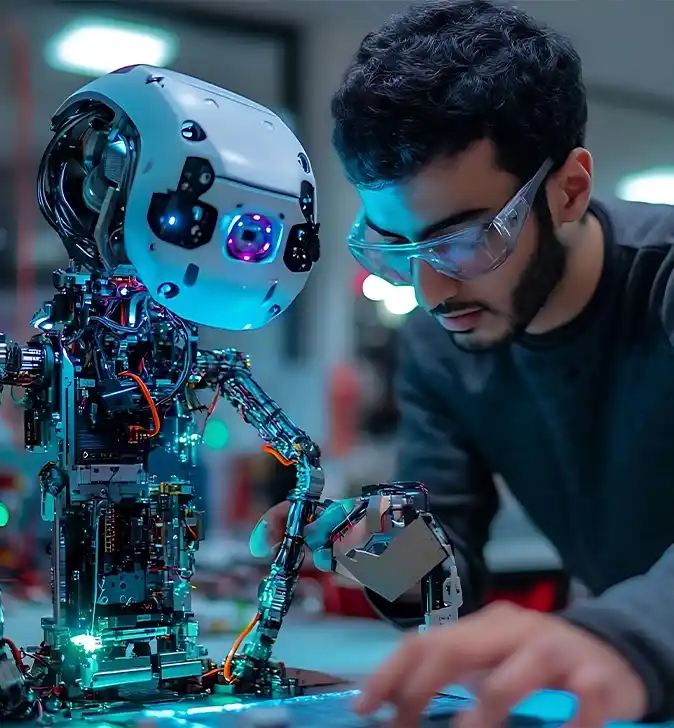
Engineering for Cognitive Robotics and Intelligent Automation

KiTE’s B.E. Robotics and Automation program is designed for the future of intelligent engineering. The curriculum extends beyond conventional textbooks, offering in-depth exposure to automation systems, robotics design, control theory, and digital manufacturing technologies.

Students engage in experiential learning through hands-on laboratory work, industry-aligned projects, and interactions with domain professionals. This rigorous blend of advanced coursework and practical application cultivates technical competence, critical thinking, and professional confidence.

Program Overview

Program Type
Undergraduate
Duration
4 Years (8 Semesters)
Department
Department of Robotics and Automation
Program Status
Autonomous (Affiliated to Anna University)
Credits Required
169 (Choice-Based Credit System)
Core Courses
14 Professional Core Papers
Elective Courses
11 Elective Papers

A Revolutionary Educational Experience

This program integrates robotics theory, practical labs, automation simulation, and real-world industrial projects to go beyond typical engineering instruction. Students gain expertise in engineering communication, automation design, and systems thinking.

Why B.E. Robotics and Automation at KGiSL Institute of Technology?

Image link
Industry-aligned autonomous curriculum
future-ready curriculum designed by academic and industry experts with an emphasis on core tech skills, professional development, and career growth.
Image link
Flipped classrooms with integrated labs
innovative project-based experiential learning with School of Innovation labs for Cloud Computing, AI, Data Analytics, Blockchain, Web 3.0, Fullstack Development, and Cybersecurity.
Image link
Active industry internships and projects
opportunity to work alongside industry professionals through guest lectures, workshops, and real-time industry projects.
Image link
KGiSL campus placement program
direct interviews with industry partners and recruiters, supported by dedicated career counsellors, placement trainers, and coordinators.

Vision and Mission

Image link

Vision

To evolve as a Prominent Department in producing Highly Competent Computer Science and Engineering Graduates contributing to the welfare of the Industry and Society at large.

Image link

Mission

To impart Quality Education with an emphasis on Software Development.
To equip our Faculty Members with Progressive Technologies.
To provide suitable Infrastructure and Resources with Modern Tools for creating a better Learning Environment.
To collaborate with Industries and Institutes for Innovative Research and Technological updates.
To inculcate the aspects of Communication, Creativity, Social and Ethical Values through various Student Participation Activities.

Objectives and Outcomes

Program Educational Objectives

PEO1

Excel in the software, hardware, and networking professions with immense knowledge in the latest technologies of the computer science field.

PEO2

Develop innovative products and solutions through high precision of analysis, computing, and problem-solving skills.

PEO3

Exhibit as lifelong, socially responsible engineers possessing high ethical and moral values needed by society.

Program Outcomes

PO1

Image link
Engineering knowledge

Apply knowledge of mathematics, natural science, computing, engineering fundamentals, and an engineering specialization, as specified in WK1 to WK4 respectively, to develop solutions for complex engineering problems.

PO2

Image link
Problem analysis

Identify, formulate, review research literature, and analyze complex engineering problems, reaching substantiated conclusions with consideration for sustainable development (WK1 to WK4).

PO3

Image link
Design / development of solutions

Design creative solutions for complex engineering problems and design/develop systems, components, or processes to meet identified needs, considering public health and safety, whole-life cost, net zero carbon, culture, society, and environment as required (WK5).

PO4

Image link
Conduct investigations of complex problems

Conduct investigations of complex engineering problems using research-based knowledge, including design of experiments, modelling, analysis, and interpretation of data, to provide valid conclusions (WK8).

PO5

Image link
Engineering tool usage

Create, select, and apply appropriate techniques, resources, and modern engineering and IT tools, including prediction and modelling, recognizing their limitations to solve complex engineering problems (WK2 and WK6).

PO6

Image link
The engineer and the world

Analyze and evaluate societal and environmental aspects while solving complex engineering problems, considering their impact on sustainability, economy, health, safety, legal framework, culture, and environment (WK1, WK5, and WK7).

PO7

Image link
Ethics

Apply ethical principles and commit to professional ethics, human values, diversity, and inclusion; adhere to national and international laws (WK9).

PO8

Image link
Individual and collaborative teamwork

Function effectively as an individual, and as a member or leader in diverse, multidisciplinary teams.

PO9

Image link
Communication

Communicate effectively and inclusively within the engineering community and society at large, including comprehending and writing effective reports and design documentation, and making presentations while considering cultural, language, and learning differences.

PO10

Image link
Project management and finance

Apply knowledge and understanding of engineering management principles and economic decision-making to one’s own work, as a member and leader in a team, and to manage projects in multidisciplinary environments.

PO11

Image link
Life-long learning

Recognize the need for, and have the preparation and ability for:

independent and life-long learning,
adaptability to new and emerging technologies
critical thinking in the broadest context of technological change (WK8).

Program Specific Outcomes

PSO1

Apply the technical skills of Data Science, Artificial Intelligence, Cloud Computing and Networking to provide solutions for industrial and societal requirements.

PSO2

Use appropriate modern tools and IDEs for real-time software development.

PSO3

Apply and adopt contemporary software development methodologies and standards which suits the dynamism of Societal and Industrial nature.

Curriculum Overview

The B.E. Robotics and Automation curriculum at KGISL Institute of Technology is guided by the Anna University regulations and uses a Choice-Based Credit System (CBCS). Spanning four years, the curriculum is designed to provide comprehensive technical depth as well as interdisciplinary flexibility.

Skill Development and Career Focus

The program includes continuous skill-building through:

Modules for Professional Skill Development per semester
Automation systems, robotics prototyping, and embedded systems labs
Robotics, event planning, and intellectual property rights entrepreneurship courses
Live projects and internships with top robotics and automation firms

How to Apply?

Gallery Section

Moments of Innovation, Exploration, and Success

A visual showcase of student excellence and department activities:

Affordable plans for individuals
Build stunning websites with Essentials
Affordable plans for individuals
Build stunning websites with Essentials
Affordable plans for individuals

How to Apply?

Candidates seeking admission to the B.E. Robotics and Automation degree course are required to submit the following certificates:

Transfer Certificate – original and 3 photocopies.
HSC / 12th Mark Statements – original and 3 attested photocopies.
SSLC / 10th Mark Statements – original and 3 attested photocopies.
TNEA Allotment Order and Counselling Call Letter – original and 3 attested photocopies.
Conduct Certificate – original and 3 attested photocopies.
Community Certificate – original and 3 attested photocopies.
Migration Certificate – original and 3 attested photocopies (for candidates from boards outside Tamil Nadu State).
Passport size Photograph – 6 Nos.

Educational Experience
Vision and Mission
Objectives and Outcomes
Career & Skills
Gallery