
Lorem ipsum dolor sit amet, consectetur adipiscing elit, sed do eiusmod tempor
M.E. Applied Electronics in Coimbatore at KG Institute of Technology, KiTE
The M.E. in Applied Electronics in Coimbatore at KG Institute of Technology (KiTE) is a postgraduate program designed to develop expertise in modern electronics, embedded systems, VLSI, and intelligent automation technologies. The program offered by one of the best ME colleges Coimbatore, bridges theoretical foundations with industry-driven applications—preparing engineers for research, innovation, and leadership in emerging fields of electronics and communication.
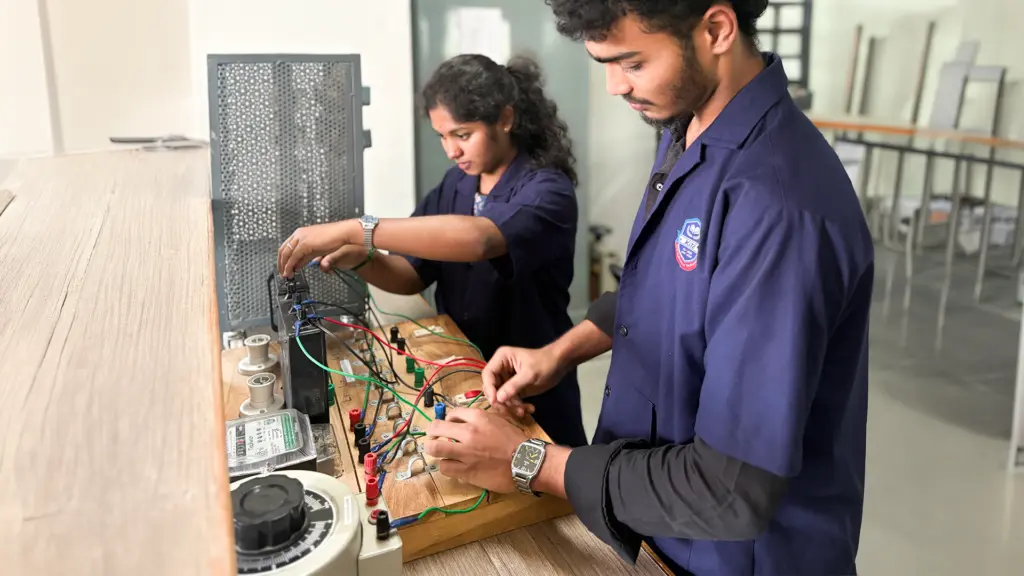
Students of the M.E. Applied Electronics in Coimbatore at KiTE, through a comprehensive blend of coursework, laboratory integration, and project-based learning, gain mastery over analog and digital system design, signal processing, IoT, microelectronics, and embedded hardware development.
Program Overview
Program Type
Duration
Department
Program Status
Credits Required
Core Courses
Elective Courses
Why Choose KiTE for M.E. Applied Electronics?

Industry-aligned autonomous curriculum

Flipped classrooms with integrated labs

Supported by ECE Research Centre

Advanced projects and active industry internships

KGiSL campus placement program
Vision and Mission

Vision
To be a Proficient Department imparting Quality Education in Electronics and Communication Engineering for developing Professionally Competent Engineers to accomplish the Technological needs of Industry and Society.

Mission
Objectives and Outcomes
Program Educational Objectives
PEO1
Have a Successful Career in Electronics and Communication Engineering or Allied Disciplines.
PEO2
Provide Innovative Solutions to Real world problems in Information and Communication Engineering.
PEO3
Exhibit excellent Communication Skills, Ethical Responsibility and Lifelong Learning ability in the chosen career.
Program Outcomes
PO1

Engineering knowledge
Apply knowledge of mathematics, natural science, computing, engineering fundamentals, and an engineering specialization, as specified in WK1 to WK4 respectively, to develop solutions for complex engineering problems.
PO2
Problem analysis
Identify, formulate, review research literature, and analyze complex engineering problems, reaching substantiated conclusions with consideration for sustainable development (WK1 to WK4).
PO3
Design / development of solutions
Design creative solutions for complex engineering problems and design/develop systems, components, or processes to meet identified needs, considering public health and safety, whole-life cost, net zero carbon, culture, society, and environment as required (WK5).
PO4
Conduct investigations of complex problems
Conduct investigations of complex engineering problems using research-based knowledge, including design of experiments, modelling, analysis, and interpretation of data, to provide valid conclusions (WK8).
PO5
Engineering tool usage
Create, select, and apply appropriate techniques, resources, and modern engineering and IT tools, including prediction and modelling, recognizing their limitations to solve complex engineering problems (WK2 and WK6).
PO6
The engineer and the world
Analyze and evaluate societal and environmental aspects while solving complex engineering problems, considering their impact on sustainability, economy, health, safety, legal framework, culture, and environment (WK1, WK5, and WK7).
PO7
Ethics
Apply ethical principles and commit to professional ethics, human values, diversity, and inclusion; adhere to national and international laws (WK9).
PO8
Individual and collaborative teamwork
Function effectively as an individual, and as a member or leader in diverse, multidisciplinary teams.
PO9
Communication
Communicate effectively and inclusively within the engineering community and society at large, including comprehending and writing effective reports and design documentation, and making presentations while considering cultural, language, and learning differences.
PO10
Project management and finance
Apply knowledge and understanding of engineering management principles and economic decision-making to one’s own work, as a member and leader in a team, and to manage projects in multidisciplinary environments.
PO11
Life-long learning
Recognize the need for, and have the preparation and ability for:
Curriculum & Specialisations
The M.E. Applied Electronics in Coimbatore at KiTE curriculum is guided by the Anna University regulations and uses a Choice-Based Credit System (CBCS). Spanning two years, the curriculum is designed to provide comprehensive technical depth as well as interdisciplinary flexibility.
Year I
Eligibility Criteria & Admission 2026
B.E./B.Tech. Degree in Electronics and Communication Engineering, Electrical Engineering, Electronics & Instrumentation, or related disciplines.
How to Apply?
Candidates seeking admission to the M.E. degree courses are required to submit the following certificates:
📞 For Admission Contact Number
Placements & Career Opportunities
Students pursuing M.E. Applied Electronics in Coimbatore at KG Institute of Technology (KiTE) have the option to specialise in various domains. Students can pursue electives and research in diverse, future-oriented domains such as:
Placements












Fees & Scholarship
Candidates who wish to enrol for the M.E. Applied Electronics admission 2026 at the KG Institute of Technology (KiTE) can check if they qualify for fees waver and scholarships.
FAQs
Candidates must hold a B.E. or B.Tech degree in Electronics and Communication Engineering (ECE), Electrical and Electronics Engineering (EEE), or a related branch with at least 50% aggregate marks. Reserved category students need 45%. Admission is based on TANCET scores followed by TANCA counselling conducted by Anna University.
The total tuition fee for the 2-year M.E. Applied Electronics program is approximately ₹50,000, making it one of the most affordable PG engineering programs in Coimbatore. Additional fees may apply for hostel, transport, and examination.
Graduates can pursue roles in VLSI design, embedded systems, signal processing, telecommunications, and semiconductor industries. Top recruiters visiting KiTE include TCS, Wipro, Infosys, IBM, Cognizant, and Capgemini. Higher studies (Ph.D) and DRDO/ISRO opportunities are also available.
Yes. KiTE holds NAAC A+ accreditation, is affiliated with Anna University, and is approved by AICTE. The institute has well-equipped ECE labs, experienced faculty, and a strong placement track record with 3,000+ campus placements since 2008.
TANCET cutoff varies each year based on the number of applicants and available seats. Candidates are advised to contact the KiTE admissions office directly or check the TANCA official portal for the most recent cutoff data.
Apply for M.E. Applied Electronics 2026
📞 For Admission Contact Number